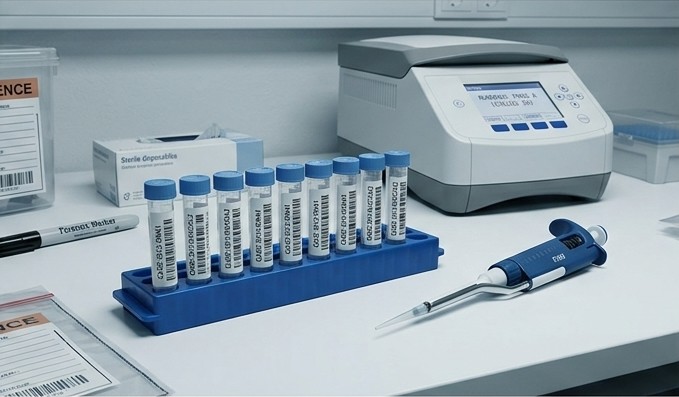
Sexual assault kit backlogs, sperm cell lysis, and the forensicGEM benchmark.
3 minutes + 10 minutes (paper)

Sexual assault kit backlogs are one of the most persistent problems in forensic science. In the United States alone, hundreds of thousands of untested kits represent cases that cannot be progressed, in part because the laboratory workflows involved are time-consuming, labour-intensive, and reagent-heavy.
The standard method for lysing sperm cell fractions from sexual assault samples involves detergents, proteinase K, and DTT, followed by purification. It works, but it requires multiple tube transfers and takes considerable bench time. Researchers at Virginia Commonwealth University set out to evaluate whether simpler, cheaper alternatives could deliver equivalent results.
The study tested seven alternative sperm cell lysis techniques against a control method. That control was forensicGEM Sperm. Every alternative was benchmarked against it. Microscopic examination confirmed that two of the alternatives (Casework Direct and alkaline lysis) could lyse all spermatozoa within samples. Crucially, quantification results showed that all methods performed comparably to the forensicGEM control (p greater than 0.06), meaning the alternatives matched, not exceeded, the established benchmark.
The conclusion was that alkaline lysis is the recommended alternative, given its speed and lower cost per reaction. But the framing of the paper is important: forensicGEM Sperm was not replaced because it underperformed. It was replaced because the goal of the research was to find something cheaper and faster for high-throughput use. forensicGEM set the standard that alternatives had to match.
For laboratories where throughput, not cost, is the primary concern, or where sample complexity or sensitivity requirements favour an enzymatic approach, the paper reinforces rather than undermines the case for enzymatic extraction. It also illustrates a broader point: when forensic researchers design comparative studies of sperm cell lysis, enzymatic extraction is the method they choose as the reference standard.