Environmental DNA and what portable extraction makes possible
2 minutes + 15 minutes (paper)

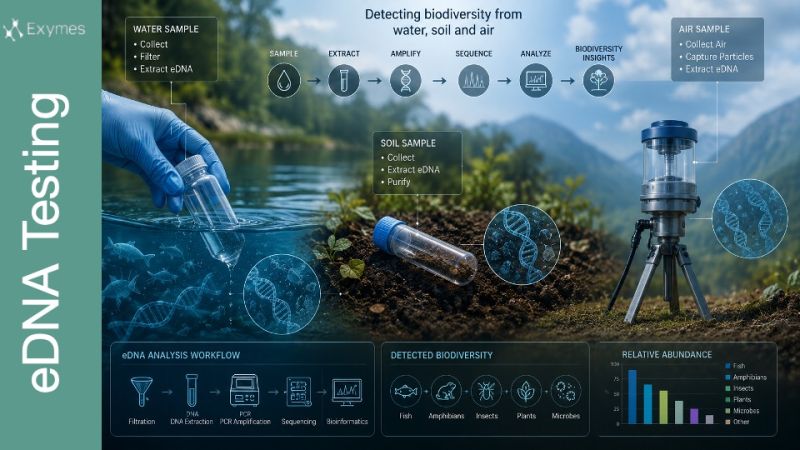
Environmental DNA is the genetic material shed by organisms into their surroundings. It has transformed ecological monitoring over the past decade. eDNA can be used to detect species presence from water, soil, or air samples without physical observation or capture. For invasive species monitoring, conservation, and biosecurity, it is increasingly the tool of choice.
The bottleneck has been the extraction step. Conventional eDNA workflows require a laboratory: centrifugation, column purification, controlled temperature environments. This limits where and when monitoring can happen.
The PDQeX and phytoGEM chemistry change that constraint. Both the cassava virus work published in PNAS (2019) and a 2025 paper in Environmental DNA (Durán-Vinet et al.) demonstrate that enzymatic extraction from environmental samples is achievable in field conditions without laboratory infrastructure. The 2025 paper used PDQeX extraction of invasive kelp tissue as the first step in a CRISPR-Cas12 biosurveillance system with AI-designed guide RNAs to detect the target without sequencing. A 2022 Environmental DNA paper (Jeunen et al.) validated passive sampling substrates for marine eDNA monitoring; PDQeX extraction performed comparably to QIAGEN in the controlled setting, though the field protocol for passive substrates requires further optimisation.
A phytoGEM extraction runs in 15 minutes on battery-powered equipment. It is compatible with leaf punches, swabs, and dried collection cards. The extract is PCR-ready without further purification.
For biosecurity agencies, conservation programmes, and environmental regulators who need to move monitoring closer to the source, that combination is practically significant.